
|
Getting your Trinity Audio player ready...
|
When the Town & Desert Apartment Hotel, now the Hideaway, opened in 1947, it was billed as the “Apartments of Tomorrow.” What a compelling prospect: not the full-service resorts that were beginning to define Palm Springs, but apartment hotels, clusters of units with varied layouts, kitchens, and shared outdoor space, closer to living than lodging.
Herbert W. Burns arrived in Palm Springs in 1946 with his wife Gayle, not as a licensed architect but as a designer who had worked in Los Angeles and served in the Army Air Corps. Working with standard materials — wood framing, stucco, concrete block — he developed plans that could be repeated across sites. Seen now, the model anticipates the “aparthotel,” organized around longer stays.
The Hideaway launches Burns’ desert career
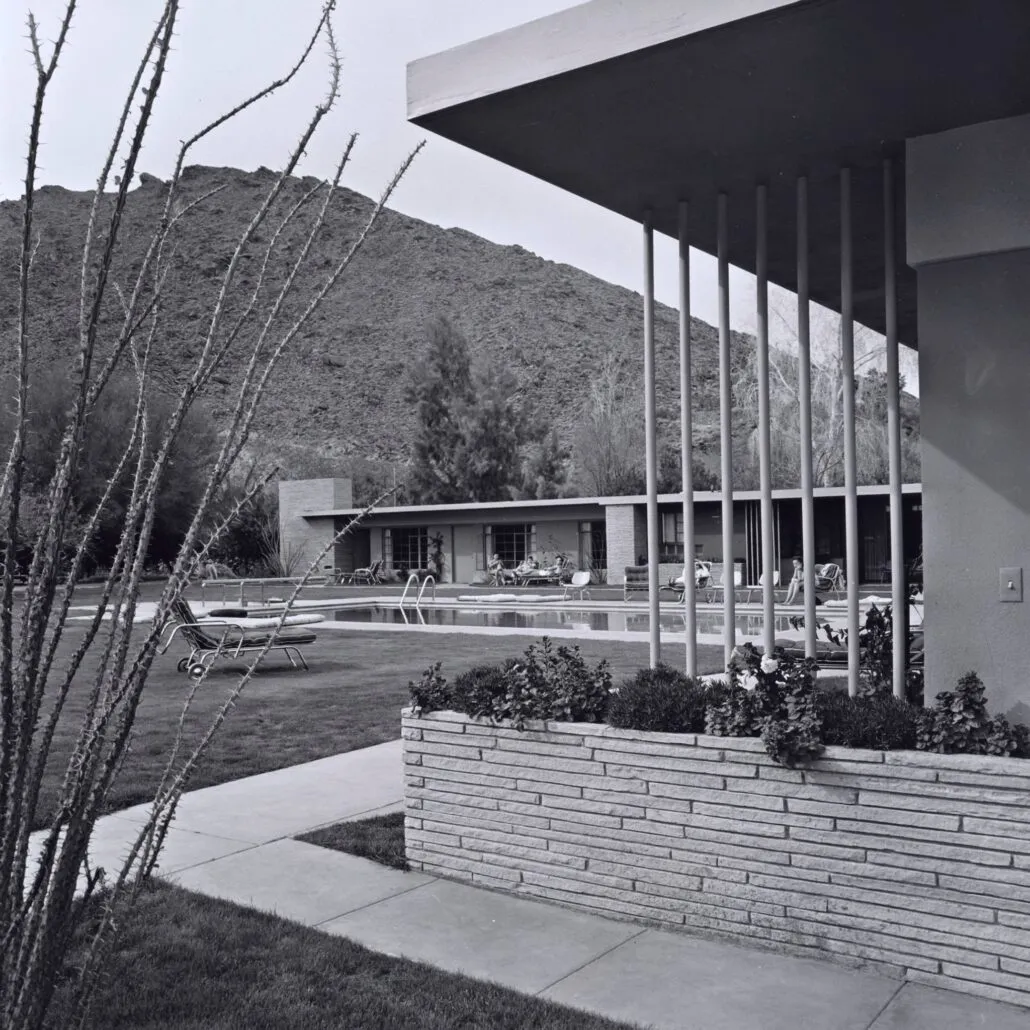
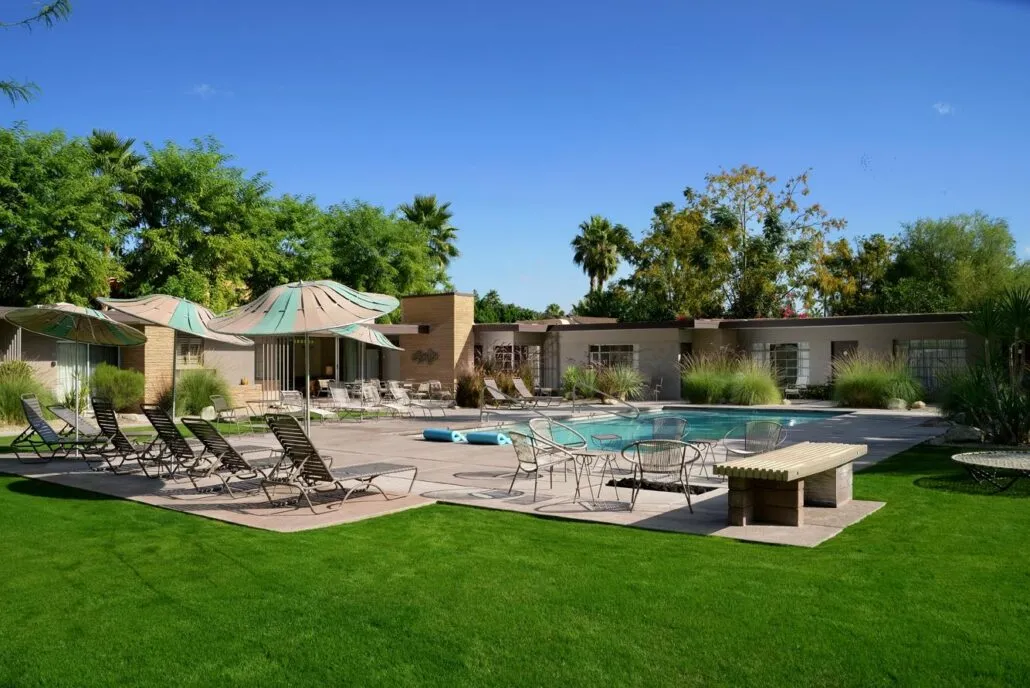
An early look at The Hideaway. Photo courtesy of The Hideaway
The Hideaway (1947) lays out the model. Burns pushes rooms to the lot’s edge, a low run with doors opening directly onto the patio. There is no buffer between room and outside. Lawn and open space extend from the thresholds, with clear views to the San Jacinto Mountains. Paths cut diagonally across the grass, more drift than direction, with plantings like agave and grasses kept low so the space reads as continuous. Then as now, lounge chairs spread across the deck, umbrellas tilt toward the sun, and the mountains rise just beyond the pool.
Units follow 10 varied plans, while vertical slat screens — a Burnsian motif — temper light. Designated a Class 1 Historic Site in 2014, The Hideaway remains one of the clearest expressions of the designer’s apartment-hotel model, which photographer Julius Shulman described as leaving “the occupant puzzled to find that subtle point where the view ends and the interior begins.”
Desert Riviera builds on Burns’ foundational design
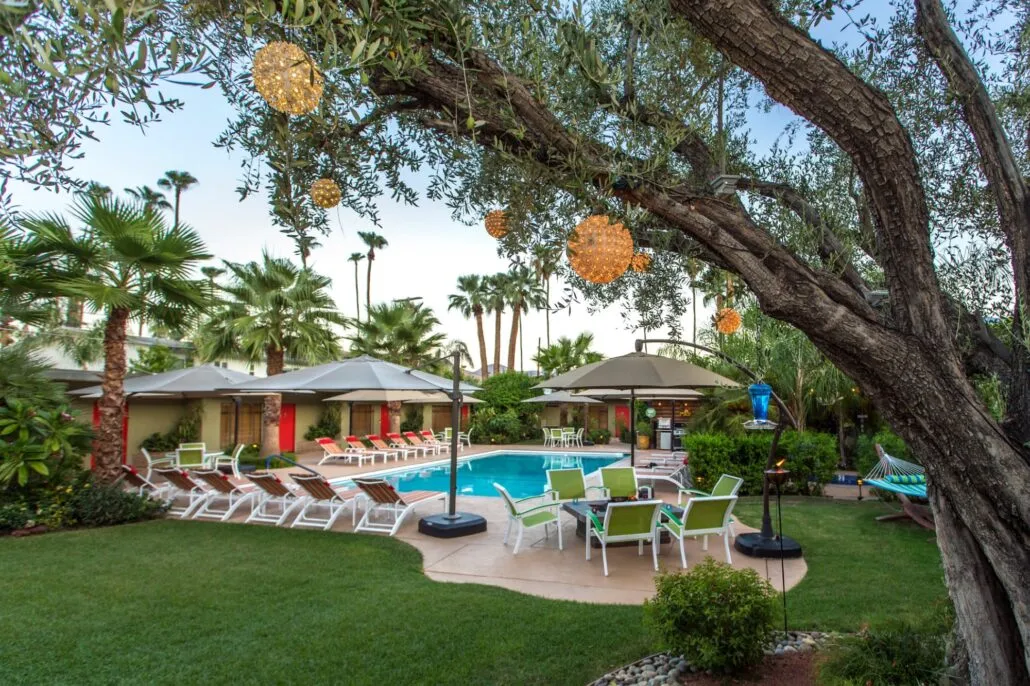
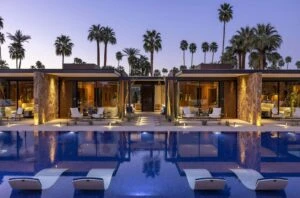
Twinkling lights add a magical touch to the Desert Riviera. Photo courtesy of Desert Riviera
By 1951, Burns tightens the model at the Desert Riviera. Units cluster around the pool in a courtyard edged with palms and dense planting that screens the property from the street. Movement tracks along the water’s edge, activity settling into that compact center. The result is quieter and more inward-facing. Tall hedges block views from Palm Canyon Drive, a small retro sign offers the only hint inside, and house rules — no children, no pets, even a half-serious ban on overnight guests — shape the atmosphere. A composed community to match a controlled layout.
Burns perfects his style at Orbit In
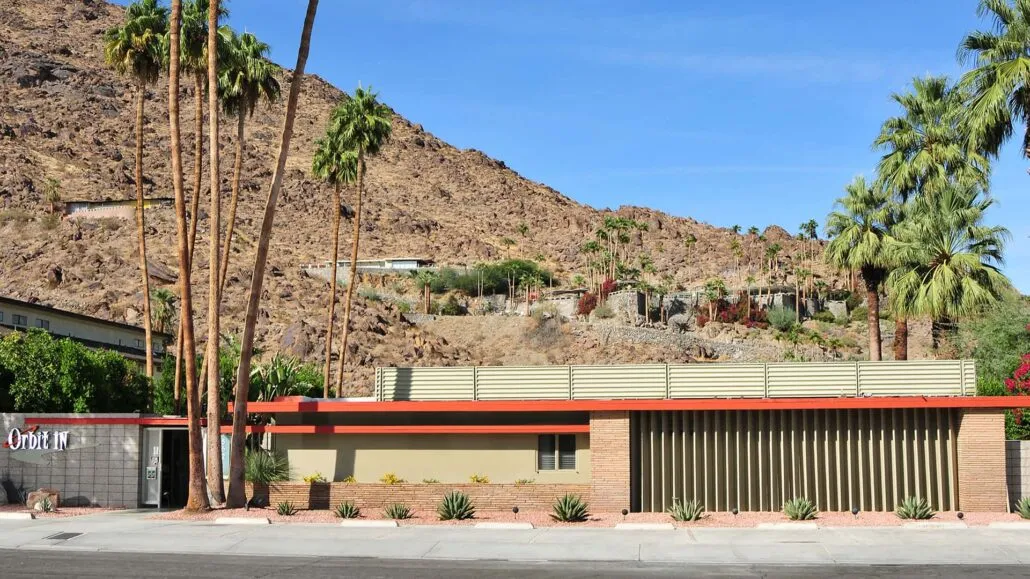
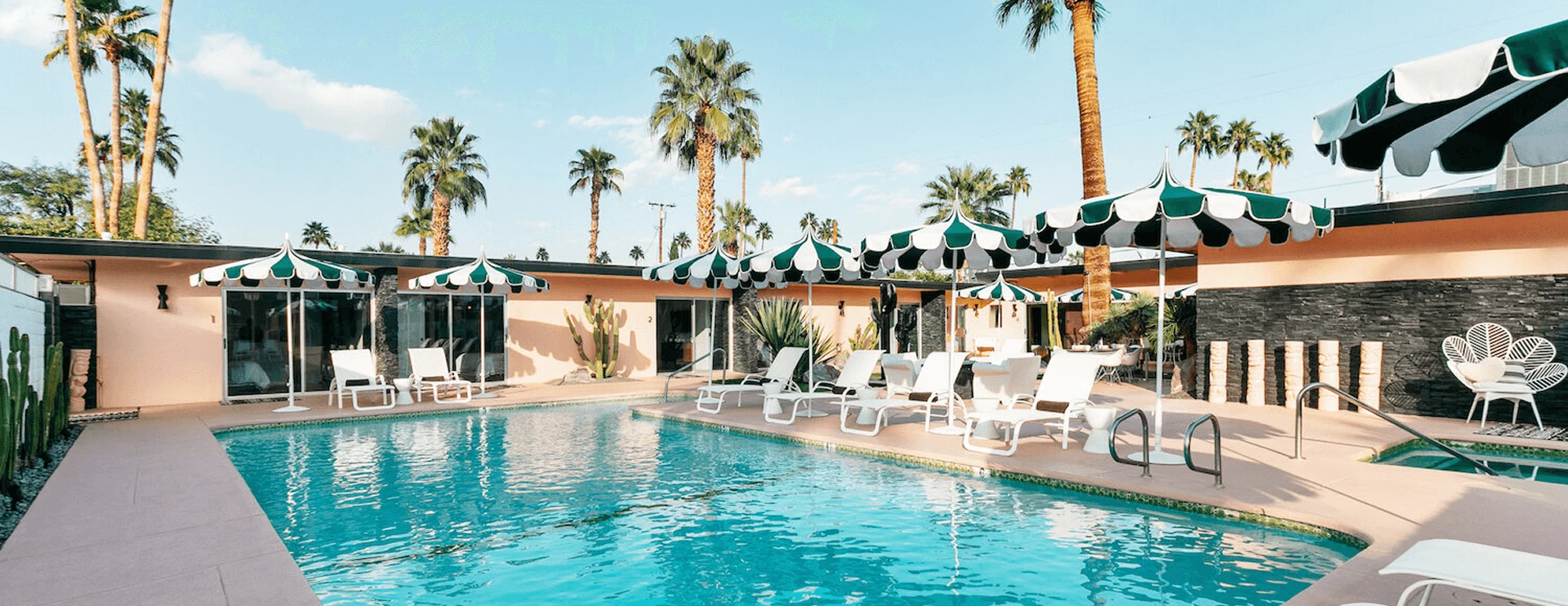
The Orbit In is a classic example of Herbert W. Burns’ work. Photo courtesy of Orbit In
With Orbit In (1955), née the Village Manor, Burns shifts from arrangement to composition. The nine-unit complex turns on repetition: vertical slat screens break the facade into bands of light and shadow, while layered eaves read as speed stripes, a nod to streamline moderne. Inside, compact units retain metal kitchenettes, pink tile baths, paneling, and built-in clocks. A 1999–2001 restoration with Palm Springs architect Lance O’Donnell added a terrazzo boomerang bar and shade structures, preserving the original fabric.
Desert Hills receives the Burns touch
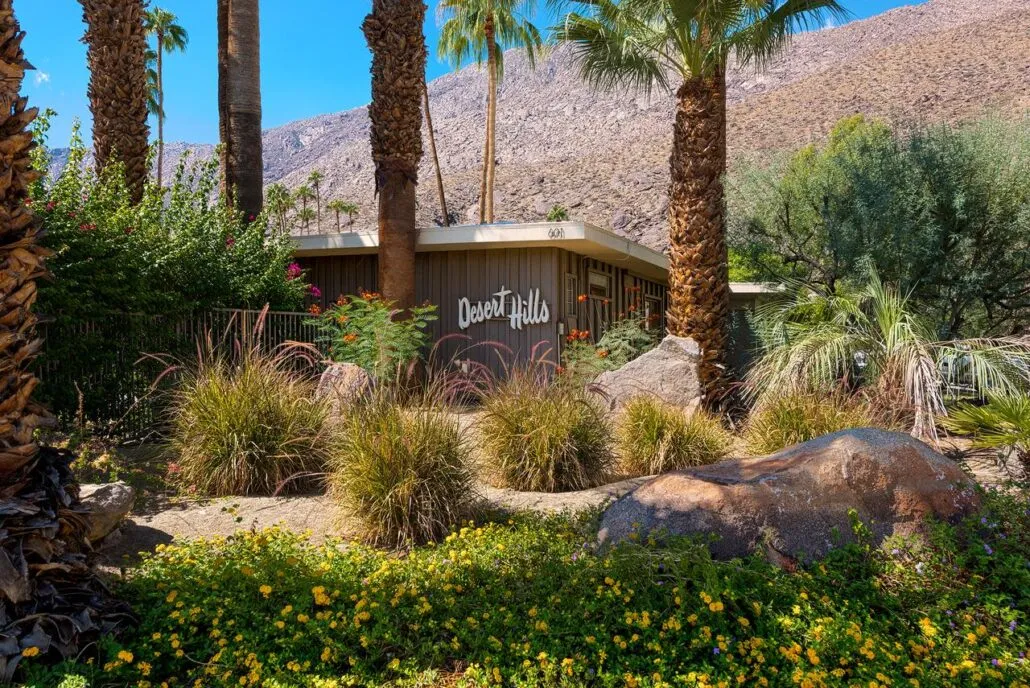
Desert Hills is another Burns project featuring great views of the San Jacinto Mountains. Photo courtesy of Desert Hills
At Desert Hills, built in the mid-1950s, Burns loosens the plan again. Low volumes step forward and back, while hedges give each doorway more privacy without full isolation. Paths curve and branch, linking patios and entries before returning to the pool. Often associated with mid-century regulars like Doris Day, the property carries a more social, lived-in character, with its coral-pink sign mounted against weathered board-and-batten and a poolside culture that, by some accounts, once included Day herself grilling hamburgers and singing.
Across these projects, Burns is concerned with how space is organized and lived in. Architectural historian Alan Hess has described his work as less austere than that of Albert Frey or John Lautner, warmer in its materials and more relaxed in its planning. Julius Shulman noted his aim to blur the line between house and desert. Buildings stay low and stretch horizontally, shaded by deep eaves, set into their surroundings rather than lifted out of them. Some Burns enthusiasts describe his work as closer to the International Style — less about formal effect than about what could be built and how it would be used.
Taking Burns into the 21st century
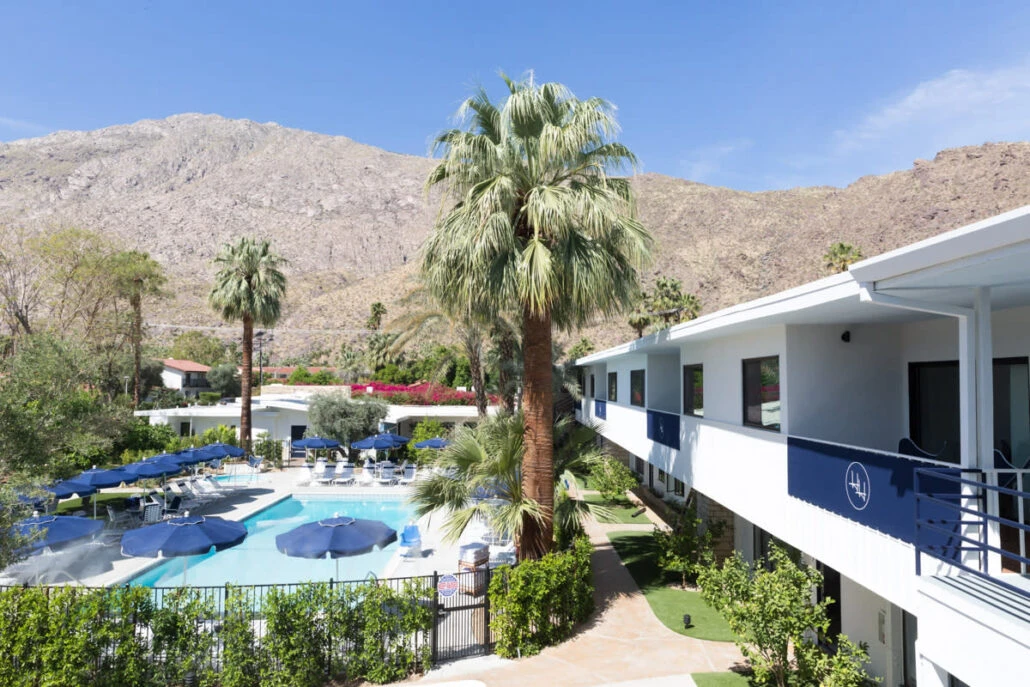
Holiday House is an example of a Burns property that has been modernized. Photo courtesy of Holiday House
Burns’ mid-century work continues to evolve, though not always in ways that preserve his original sensibility, and often under new ownership. Holiday House has been recast as a design-forward boutique hotel, its interiors reimagined by Los Angeles designer Mark D. Sikes for a 2017 reopening. The building itself has been substantially reworked: portions have been built up to a second story, and the original desert materials are now largely masked by a uniform white finish, with only fragments of the original single-story design still discernible. At Terra Palm Springs, a similarly sweeping remodel has recast the property as a desert-bohemian wellness retreat, with few traces of Burns’ architectural language remaining.
Other properties fall somewhere in between. What is now The Velvet Rope (originally the Desert-Ho) retains much of Burns’ original footprint and massing, even as its surfaces have been updated, while La Maison has been extensively reworked into a Mediterranean-style property, with only a handful of original details remaining. The Three Fifty, often attributed to Burns, has been disputed by some experts.
Today, four Burns-designed hotels — Hideaway, Desert Riviera, Desert Hills, and Orbit In — are operated by Town & Desert Hospitality. CEO David Dean first encountered the properties as a guest and now focuses on preserving what makes them distinct, not sanding them down into something sleeker but holding onto their original character. “It’s not a spaceship,” he said, echoing Mad Men. “It’s a time machine.”