
|
Getting your Trinity Audio player ready...
|
Hugh Kaptur didn’t arrive in Palm Springs with a signature style; he arrived with a way of thinking.
Born in Detroit in 1931 and trained in architectural engineering (his father worked at General Motors), he brought a “build-first” mindset to the desert, originating projects from how the buildings would be made and used, not just how they looked. After relocating to Palm Springs in the mid-1950s, he worked under architect Donald Wexler of Steel Development Houses fame before establishing his own practice.
Kaptur’s five-decade career spans more than 200 projects across the Coachella Valley, an oeuvre that remarkably resists a single, recognizable look. “I didn’t want all my buildings looking the same…I tried to make every one of my buildings different, to give it its own personality,” he once said.
That instinct may be clearest in his boutique hotels, where small-scale design has to funnel quickly into a favorable first impression. Guests arrive, step out of the car, and within seconds need to know how to get to all the important spaces: lobby, room, pool, bar. The building handles wayfinding through form, using shape, shade, and layout as a kind of map.
The start of something special: Impala Lodge/Triangle Inn Palm Springs
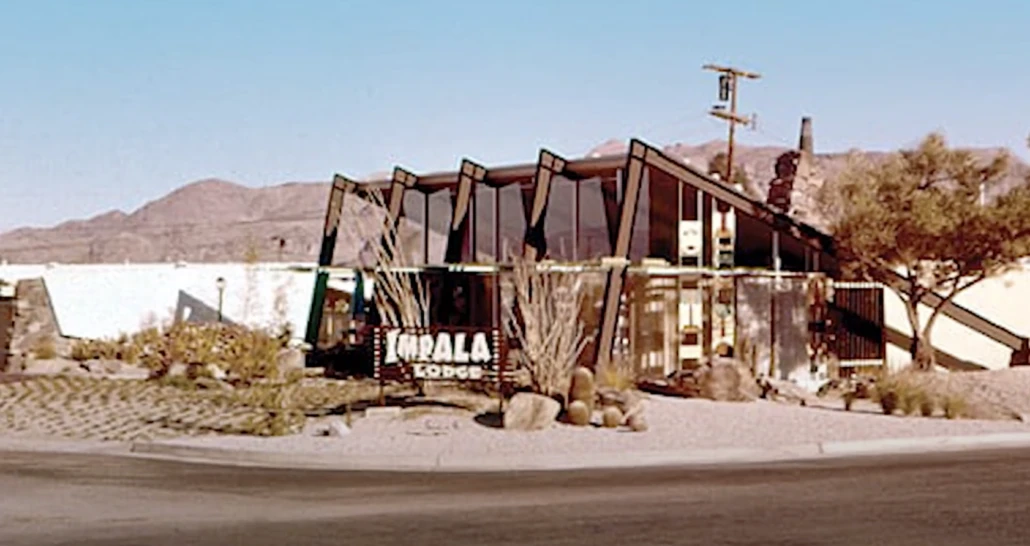
The Impala Lodge in its early days. Photo courtesy of Triangle Inn Palm Springs
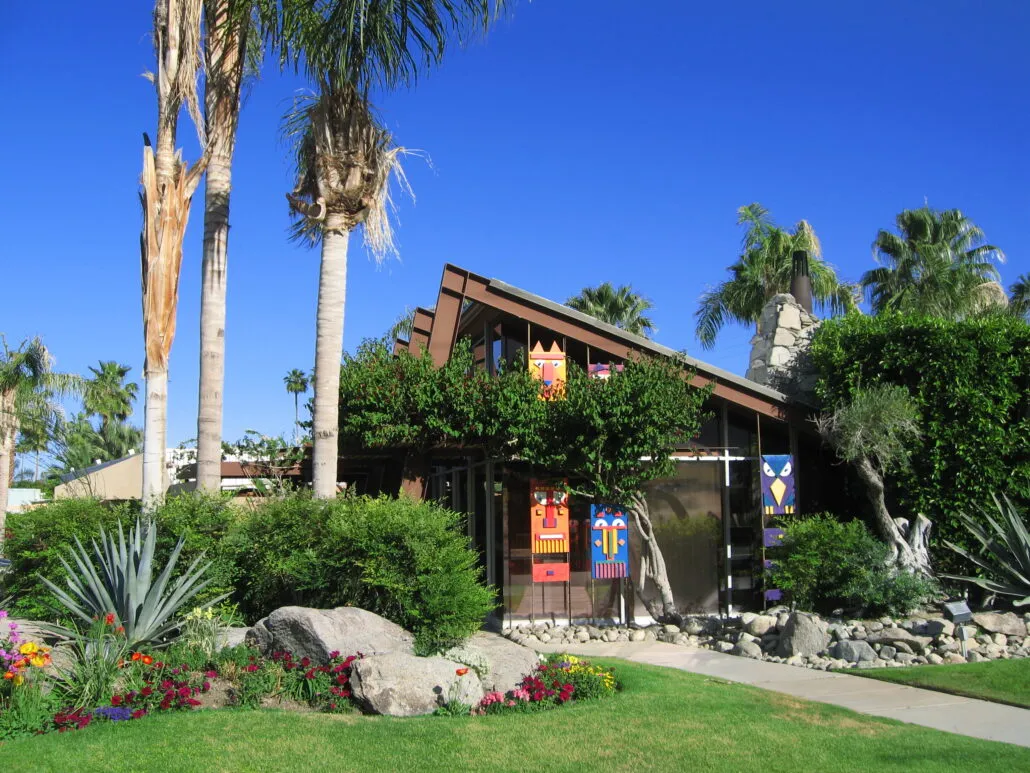
Kaptur’s first independent project, the Impala Lodge (1957–58), now the men’s clothing-optional Triangle Inn Palm Springs, starts that steering from a distance. Set just off Palm Canyon Drive, it relies less on signage than on a striking silhouette — a series of angular steel frames that read, in the architect’s words, as “mountain profiles,” pushing against modernism’s trademark horizontality — to announce its presence. You don’t search for the building; it catches your eye and draws you closer.
Those peaks echo the San Jacinto range in the near distance. Kaptur later described wanting to create architecture that “blend[s] into the natural surroundings…the hillsides and so on,” drawing on natural or organic shapes. At the Impala, the same steel frames are a practical choice for the desert — steel won’t warp, buckle, or crack, and it’s strong enough to hold big panes of view-finding glass. Repeated across the façade, the frames set up a rhythm that guides movement and casts shifting shadows throughout the day. Such ephemerality shapes the space as much as the steel, and is also an expression of Frank Lloyd Wright’s “dotted line” concept, a ribbing of light, shadow, light, shadow that was developed in the Arizona desert in the 1930s.
A symphony of style: Casa Blanca Motor Hotel/Musicland Hotel
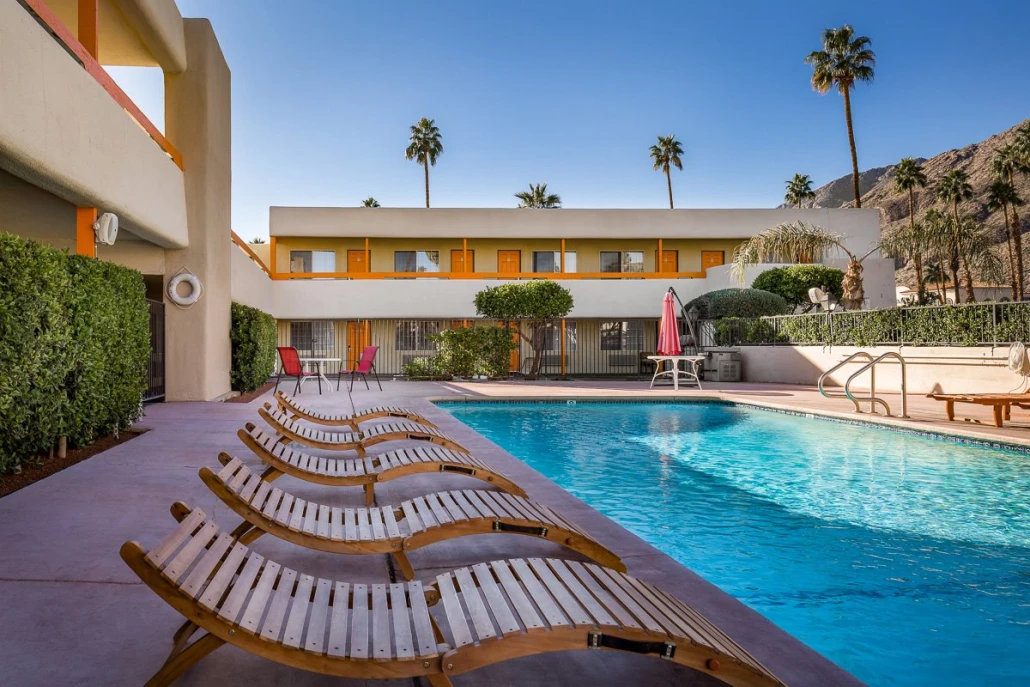
Musicland Hotel is a different kind of Kaptur property. Photo courtesy of Musicland Hotel
By the time of the Casa Blanca Motor Hotel (1970), later the Musicland Hotel, Kaptur temporarily set those steep profiles aside. In their place: thick, white stucco walls and long, horizontal openings, including a continuous band of second-story windows framed by what is widely characterized as a sculptural “eyebrow,” though it functions more like an oblong oculus. The building turns inward toward a central courtyard, and its thick stucco walls — a strategy borrowed from adobe Pueblo architecture — absorb heat during the day and release it slowly after dark, keeping interior temperatures more even.
One of Kaptur’s defining works, Tahquitz Plaza (1974–77), carries those ideas into a commercial setting. Here, the architect said he was able to “explode out of the [modernist] box,” bringing back the mountain silhouettes in a new way: two large, asymmetrical forms that slope in opposite directions and rise above the otherwise low-slung retail campus. Elsewhere, the buildings round generously at the corners, the stucco shaped into curving surfaces rather than rectilinear planes, in line with the organic forms he sought to incorporate.
Elements of Kaptur: Bahama Hotel/The Cole Hotel
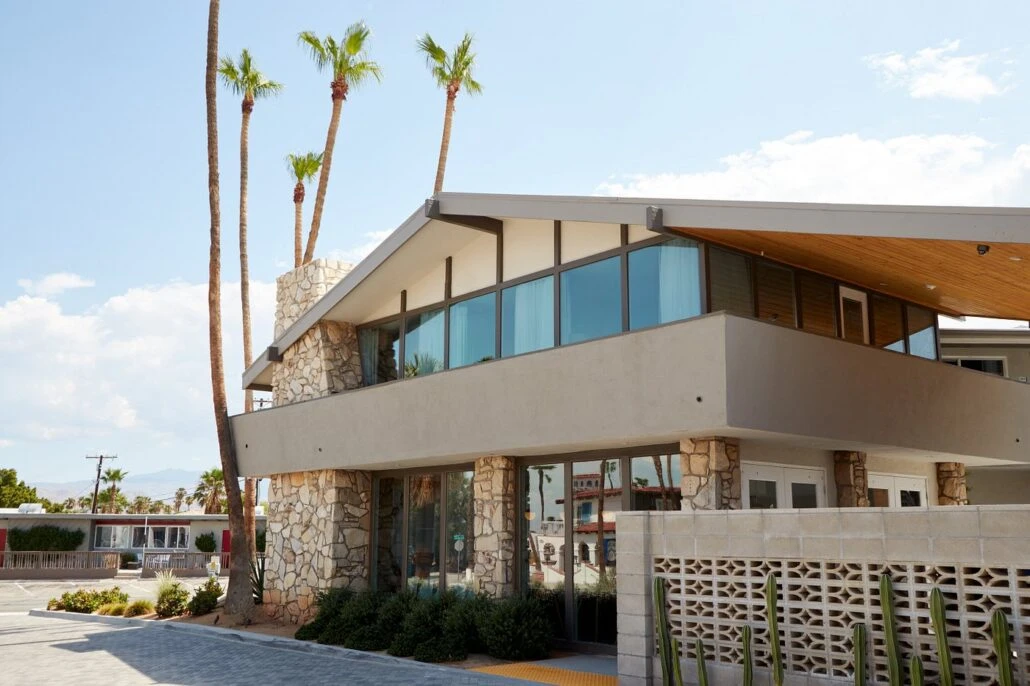
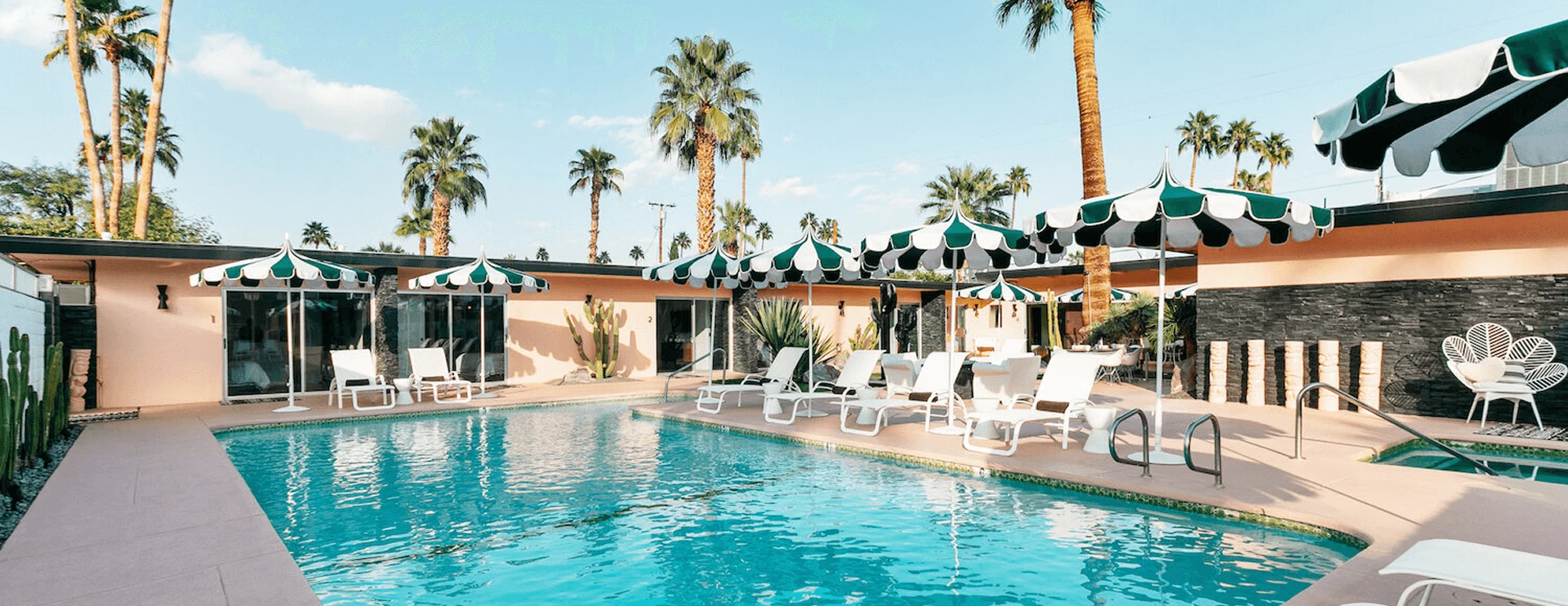
The Cole kept its original mid-century modern elements. Photo courtesy of The Cole
Kaptur’s role on the Bahama Hotel (1959), now The Cole Hotel, was partial — limited to exterior elements, including its concrete breeze-block screens, a decorative element that also provides privacy and airflow — which complicates the clear progression of his hotel designs. Even so, the layout — a row of rooms opening toward a central pool, with circulation al fresco rather than through dark interior hallways — lands on familiar ground, which might suggest his influence on the project as a whole.
“Keep the proportions good, keep it pleasing, and it will be noticed through its elegance,” Kaptur once said. Across his work, the forms may change — peaks and planes, curves and brows — but the language accumulates and evolves. These are buildings that don’t just capture your attention — they hold it, and you.